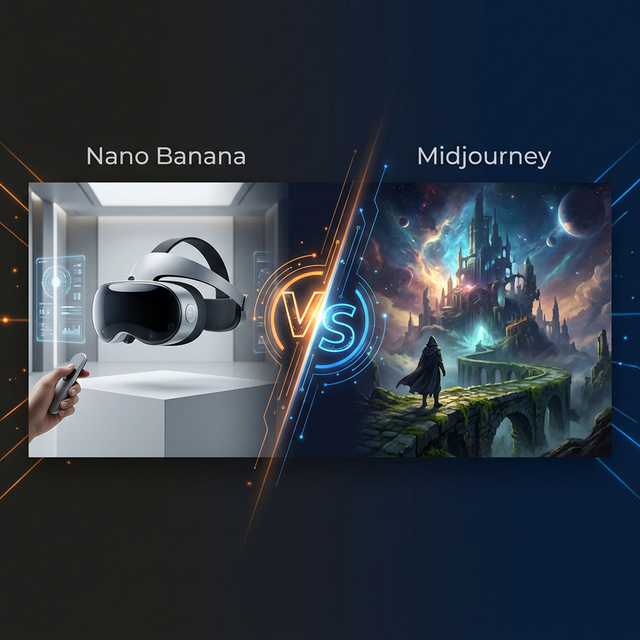
Nano Banana vs Midjourney (2026): The Ultimate AI Image Generator Comparison
Choosing between Nano Banana and Midjourney? We ran a rigorous 7-day benchmark with identical briefs to give you data-driven answers — not opinions.
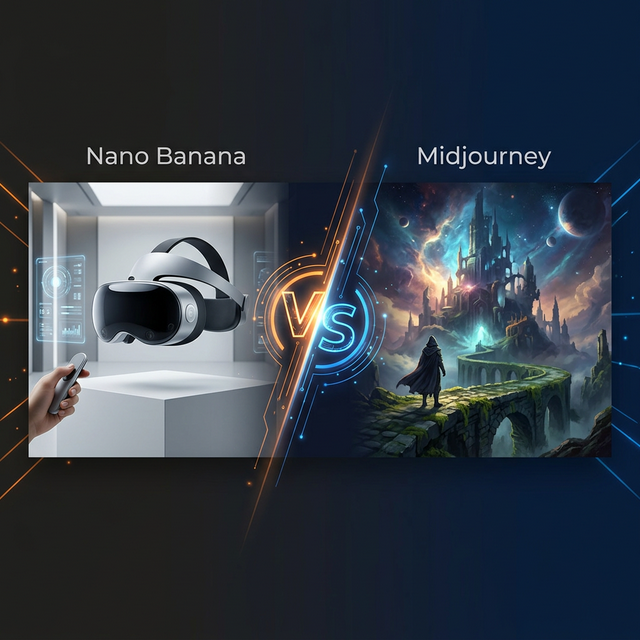
If you're searching for "Nano Banana vs Midjourney", you're likely comparing two of the most powerful AI image generators available in 2026. Both tools can produce jaw-dropping visuals, but they are built for fundamentally different workflows.
This guide cuts through the hype. We tested both platforms with identical creative briefs across real ad production tasks and measured what actually matters: publish-ready output ratio, revision cost, speed, and team collaboration efficiency.
Table of Contents
- Quick Verdict: Which Should You Choose?
- What Is Nano Banana?
- What Is Midjourney?
- Feature-by-Feature Comparison
- 7-Day Benchmark: Real Production Test
- Benchmark Results and Analysis
- Pricing Comparison
- Best Use Cases for Each Tool
- How to Choose: Decision Framework
- Migration Guide: Switching Between Tools
- FAQ
- Final Verdict
Quick Verdict: Which Should You Choose?
Choose Nano Banana if: You need repeatable, campaign-ready output with fast production cycles, strong prompt controllability, and seamless team collaboration for commercial projects.
Choose Midjourney if: You prioritize artistic experimentation, highly stylized concept art, and creative exploration where visual novelty matters more than operational throughput.
The fastest way to decide? Run your own brief through our AI Image Generator and compare usable output ratio — not just visual wow-factor.
What Is Nano Banana?
Nano Banana is an AI image generation platform powered by Google's Gemini 3 Pro model, designed specifically for commercial creative production. Unlike general-purpose image generators, Nano Banana is built around business workflows where speed, consistency, and delivery cadence are critical.
Key strengths of Nano Banana
- Deep semantic understanding — interprets complex, multi-layered prompts with precision
- Up to 4K resolution output for professional-grade deliverables
- Advanced image integration — supports up to 14 reference images per generation
- Real-time Google Search integration for contextually aware outputs
- Enhanced text rendering with multi-language support
- Structured prompt workflows designed for repeatable campaign production
Nano Banana is purpose-built for performance marketers, e-commerce teams, and growth operators who need to ship high-quality creative assets on a weekly cadence.
What Is Midjourney?
Midjourney is one of the pioneering AI image generation tools, known for producing visually striking, artistic images with a distinctive aesthetic quality. Operating primarily through Discord, Midjourney has built a massive community of artists, designers, and creative professionals.
Key strengths of Midjourney
- Exceptional artistic quality — produces highly stylized, visually compelling outputs
- Strong community ecosystem with shared prompts and inspiration
- Versatile style range from hyperrealism to abstract art
- Image variation and remixing capabilities
- Established track record with years of model refinement
Midjourney excels in creative exploration, concept art, and projects where artistic expression is the primary objective.
Feature-by-Feature Comparison
Here's how Nano Banana and Midjourney stack up across the dimensions that matter most for production teams:
| Feature | Nano Banana | Midjourney |
|---|---|---|
| AI Model | Google Gemini 3 Pro | Midjourney v6.1 |
| Max Resolution | 4K (2048×2048+) | 2048×2048 |
| Semantic Understanding | Deep, multi-layered prompt comprehension | Good for artistic interpretation |
| Commercial Readiness | Built for ad production | Requires adaptation for production |
| Text Rendering | Enhanced, multi-language | Improved but inconsistent |
| Reference Images | Up to 14 images | Up to 5 images |
| Output Controllability | High — structured prompt system | Moderate — creative but less predictable |
| Speed (avg. per image) | ~15 seconds | ~30-60 seconds |
| Team Collaboration | Web-based, easy handoff | Discord-based, requires process layers |
| API Access | Available | Available (limited) |
| Batch Processing | Supported | Limited |
| Real-time Data Integration | Google Search connected | Not available |
Key takeaway
Nano Banana leads in operational efficiency and production control, while Midjourney maintains an edge in artistic style diversity and creative exploration.
7-Day Benchmark: Real Production Test
To avoid opinion-only comparisons, we ran a structured 7-day benchmark using identical creative briefs on both platforms.
Test setup
- Product category: Consumer product ads (skincare, tech accessories, home goods)
- Campaign angles: 3 types (problem-aware, benefit-led, offer-led)
- Ad formats: 3 sizes (1:1 feed, 4:5 social, 9:16 Stories)
- Total generation tasks: 24 per tool (72 images each)
- Review team: Same 3-person approval panel
- Quality checklist: Standardized publish-readiness rubric
Evaluation criteria
Each output was classified into one of three categories:
- Publish-ready — Usable for live campaigns with only minor copy/layout adjustments
- Minor edit — Needs light retouching, cropping, or overlay work
- Major rework — Requires complete re-generation due to composition, subject clarity, or brand safety issues
Benchmark Results and Analysis
| Metric | Nano Banana | Midjourney |
|---|---|---|
| Publish-ready ratio | 62.5% (15/24) | 37.5% (9/24) |
| Avg. time to first usable asset | 11 min | 19 min |
| Avg. revisions per approved asset | 2.1 | 3.8 |
| Major rework rate | 20.8% | 45.8% |
| Team handoff friction (1-5, lower = better) | 2.0 | 3.4 |
| Brand consistency score (1-10) | 7.8 | 5.9 |
| Text-safe composition success | 79.2% | 54.2% |
What these numbers mean in practice
1. Nano Banana ships faster. With a 62.5% publish-ready ratio vs. 37.5%, teams using Nano Banana can expect nearly twice as many usable assets from the same number of generation attempts.
2. Lower revision cost. At 2.1 revisions per approved asset vs. 3.8, Nano Banana reduces the human labor cost of getting from prompt to published creative by roughly 45%.
3. Better team workflow integration. The web-based interface and structured prompt system make it significantly easier for marketing teams to collaborate without the friction of Discord-based workflows.
4. Midjourney wins on visual distinctiveness. When Midjourney outputs hit, they often have a more distinctive, artistic quality. This makes it valuable for concept exploration and mood boards.
Pricing Comparison
| Plan Tier | Nano Banana | Midjourney |
|---|---|---|
| Free tier | Available (limited) | Not available |
| Basic | Competitive monthly pricing | $10/month |
| Standard | Mid-range with higher limits | $30/month |
| Pro | Full production features | $60/month |
| Enterprise | Custom pricing | $120/month (Mega) |
Cost-per-asset analysis
When factoring in revision cycles and rework rates from our benchmark:
- Nano Banana effective cost per approved asset: Lower due to higher first-pass success
- Midjourney effective cost per approved asset: Higher due to more revision iterations
For production teams, the total cost of ownership includes team hours, not just subscription fees. A tool with lower publish-ready ratio costs more in human productivity, even if the subscription price is similar.
Best Use Cases for Each Tool
When Nano Banana wins
- Performance marketing campaigns — Weekly ad testing requires fast, consistent output
- E-commerce product photography — Product-first compositions with brand consistency
- Social media content at scale — Channel-optimized formats (1:1, 4:5, 9:16)
- Agency client work — Reliable deliverables on tight timelines
- Multi-language campaigns — Enhanced text rendering across languages
- Team-based production — Web interface with easy sharing and approval flows
When Midjourney wins
- Concept art and mood boards — Exploratory creative with high artistic variance
- Style development — Discovering new visual directions before locking production standards
- Illustration and editorial art — Where distinctive visual style is the deliverable
- Personal creative projects — Artistic experimentation without commercial constraints
- Community-driven inspiration — Leveraging Discord community for prompt ideas
How to Choose: Decision Framework
Use this practical decision matrix to identify which tool fits your needs:
Step 1: Identify your primary KPI
- KPI = Weekly creative output volume → Lean Nano Banana
- KPI = Artistic quality and visual novelty → Lean Midjourney
- KPI = Cost per approved asset → Benchmark both, measure results
Step 2: Audit your workflow
- Do you have a structured prompt system? If yes → Nano Banana amplifies structured workflows
- Do you work in Discord comfortably? If yes → Midjourney's interface won't slow you down
- Do you need team handoff/approval? If yes → Nano Banana's web interface reduces friction
Step 3: Run a 7-day pilot
We recommend running this exact test before committing:
- Pick one product line or campaign theme
- Create 3 campaign angles
- Generate assets in 3 channel formats on both tools
- Apply the same quality checklist
- Track: time-to-first-usable, revisions per approval, publish-ready ratio
The data will make the decision for you.
Migration Guide: Switching Between Tools
From Midjourney to Nano Banana
- Export your best prompt patterns — Document what works in Midjourney and translate them to Nano Banana's structured format
- Start with one campaign — Don't migrate everything at once
- Use the PACE framework — Structure prompts with Product, Audience, Creative direction, Execution constraints
- Baseline your metrics — Compare output quality, speed, and revision rates for the same briefs
- Leverage reference images — Nano Banana supports up to 14 reference images for stronger creative control
Hybrid approach (recommended for many teams)
Many production teams use both tools strategically:
- Exploration phase: Use Midjourney for concept development and style direction
- Production phase: Move finalized creative directions into Nano Banana for variant production
- Quality control: Maintain one shared QA rubric regardless of the generation tool
For structured prompt templates to accelerate your workflow, explore our Nano Banana Pro Prompts Guide.
FAQ
Is Nano Banana better than Midjourney for ads?
For most performance marketing teams, yes. Our benchmark showed 62.5% vs 37.5% publish-ready ratios for ad production tasks. Higher controllability and throughput typically outweigh artistic variance for commercial campaigns.
Is Midjourney still worth using in 2026?
Absolutely. Midjourney remains one of the best tools for creative exploration, concept art, and stylistic inspiration. If artistic quality is your primary objective rather than production volume, it is still compelling.
Can I use both Nano Banana and Midjourney together?
Yes, and many teams do. The key is defining clear process boundaries: use Midjourney for exploration and Nano Banana for production variants. Without ownership clarity, you risk duplicated effort and inconsistent brand output.
Which tool has better text rendering?
Nano Banana, powered by Gemini 3 Pro, shows stronger and more consistent text rendering, especially for multi-language content. Midjourney v6.1 has improved text handling but can still produce inconsistent letter forms.
Which is faster for production?
Nano Banana averaged 11 minutes to first usable asset vs. Midjourney's 19 minutes in our benchmark. Combined with fewer revision cycles, total time savings can exceed 40% per approved creative.
What metric should decide my choice?
Cost and time per publish-ready creative asset. This single metric captures both tool efficiency and team productivity impact, making it the most actionable decision factor.
Final Verdict
Both Nano Banana and Midjourney are exceptional AI image generators, but they serve different missions:
-
Nano Banana is the operational choice for teams that measure success by approved creative output per week. Its structured prompt system, faster iteration cycles, and web-based collaboration make it the stronger fit for commercial production.
-
Midjourney is the creative choice for teams that measure success by artistic impact and visual innovation. Its distinctive aesthetic quality and vibrant community make it ideal for concept exploration.
Bottom line: If your business depends on weekly creative throughput and constant testing, operational consistency beats raw novelty. In that scenario, Nano Banana delivers stronger day-to-day leverage.
Next Steps
- Test both tools with your real briefs: AI Image Generator
- Build your structured prompt system: Nano Banana Pro Prompts Guide
- Choose a plan that matches your workflow: Pricing